


Influence of AI: Future-proofing Workspaces
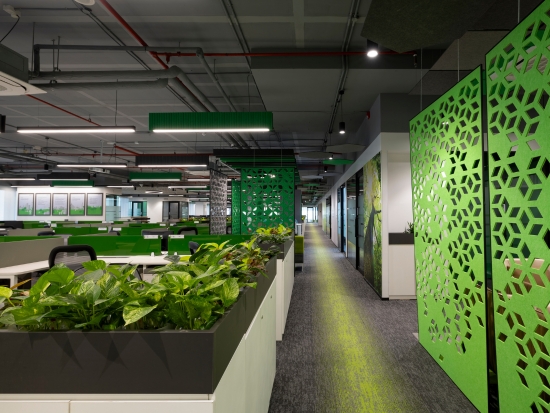
In the last decade, workspaces have transformed significantly, making way for new paradigms of work culture. Rigid cubicles and cramped workstations have been replaced by open floor layouts and ergonomic, comfortable work desks. The COVID-19 pandemic accelerated this shift, catalyzing a hybrid era where flexibility, technology, and well-being intersect.
But as we move towards the future, Artificial Intelligence (AI) is becoming the new force that is reshaping how we design, analyze, and experience workspaces. The integration of AI is enabling offices to effectively study, learn, and adapt to the evolving needs of users, making AI an integral aid in creating adaptive and responsive workspaces
The Intelligence Layer in Workspace Design
AI is redefining how we understand human behaviour and spatial performance. Collecting data from occupancy sensors, environmental control systems, and digital user feedback, AI helps in decoding how people are using a particular space, when they are using it, and what improves their well-being and productivity.
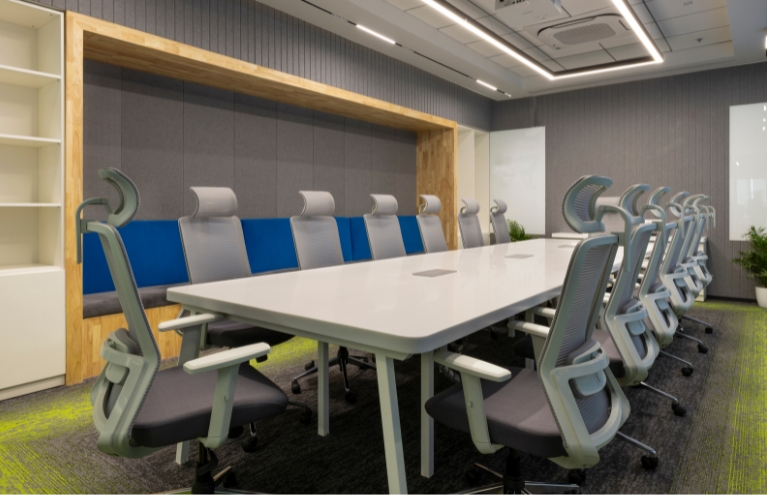
These data-driven insights from AI become a guiding path for designers to create responsive environments, resulting in workspaces that adjust lighting, acoustics, and temperature in real time. Imagine you walk into a meeting room, and the space automatically lights up as per the number of people present in the room, or you walk into an isolated private cubicle for focused work, and all the outside noise is tuned out to create a silent space for you. The integration of AI-powered systems makes these adaptive capabilities of a space come true in practicality.
At GM Desiign, we see AI as a means to enhance our intuition and amplify our understanding of how people think, feel, and perform.
Designing with Intelligent Data
A future-ready workspace is essentially one where design, data, technology, and well-being seamlessly coalesce. It is space that responds dynamically to context and adapts to the specific task, mood, and purpose.
A few key parameters of AI-enabled workspaces can be:
- Responsive Layouts – AI collects data on movement and occupancy and helps in mapping spatial usage, leading to layouts that evolve with shifting team structures. Spaces can transform from collaborative hubs to private focus zones with minimal intervention.
- Customizable Environmental Systems – Lighting, temperature, and ventilation adjust automatically to human presence and comfort levels through automatic intelligent sensors. Beyond energy efficiency, this responsiveness fosters physiological and psychological well-being.
- Predictive Maintenance & Space Utilization – AI identifies underused and over-stressed areas, suggesting real-time reconfiguration solutions, and also helps in creating a maintenance schedule to keep the spaces clean regularly. This ensures that every distinct space keeps performing at its best capability at all times.
- Predictive Maintenance & Space Utilization – AI identifies underused and over-stressed areas, suggesting real-time reconfiguration solutions, and also helps in creating a maintenance schedule to keep the spaces clean regularly. This ensures that every distinct space keeps performing at its best capability at all times.
- Human-centric Personalization – AI tailors micro-environments to specific user preferences, like seating ergonomics, preferred shades of lighting, and modular furniture settings, among other customizations, making the workspace genuinely personal and inclusive.
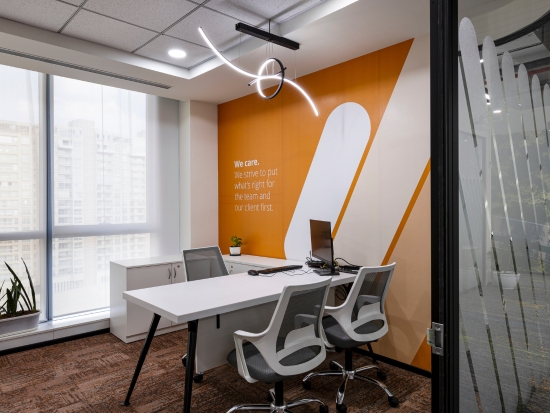
Through these integrations, AI becomes an invisible yet impactful design tool shaping the rhythm, comfort, and energy of everyday work life.
Humanizing the Smart Workplace
The intense appeal of using AI in every aspect of design needs to be mindfully balanced with humanity. A workspace that feels overly mechanized can alienate the very people it aims to empower. Design must preserve the emotional warmth of the human experience through diverse textures, abundant natural light, vernacular materiality, and a sensory harmony.
The role of the designer revolves around bridging the gap between intelligent data and human emotions, and tactful precision and a sensorial narrative of spaces. AI provides the technological insight, but human empathy gives it meaning and makes the space usable.
We believe that a truly efficient workspace needs to feel intuitive, fluid, and effortless, a space where technology enhances, and not overwhelms, the well-being and growth of the users.
AI is leading the way towards Future-ready Workspaces
Future-ready workspaces can be defined as adaptive, sustainable, and deeply human-centric spaces meant to enhance the creativity, comfort, and productivity of people. AI is reshaping the fabric of workplace design, transforming workspaces into intelligent ecosystems that self-learn, analyze productivity rhythms, predict spatial demand, and evolve dynamically without human intervention.
Although amid this transformation, the essence of design needs to remain rooted in empathy, ethics, and inclusivity, ensuring technology serves people and not the other way around.
We strive to create spaces that sense, learn, and grow with their occupants. We focus on building workspaces where design adapts, data becomes insight, and technology empowers human potential to thrive.